
Timshel? God Forbid

Timshel, Desire, and the Divine Art of Divide and Rule in East of Eden
I haven't read Steinbeck. In recent weeks I've discovered that I'm in good company: people lucky enough to be lazy, lounging, never crouching (knees, you know), in front of the screen with my little sins in the shape of nuts (scattered generously over vanilla or coconut ice cream, depending on the company), and still getting a taste of the tempestuous saga he cooked up. Much of its turbulence comes from the superb portrait of Cathy/Kate: not just another femme fatale, but evil personified, struggling to recognize and justify itself, in part by seeing and exposing the evil around it.
"It has everything in it I have been able to learn about my craft or profession in all these years," Steinbeck wrote. He might well have added, "and about my life, for that matter," for East of Eden was also a deeply personal story. Steinbeck makes himself almost explicitly present in the novel, especially in the enigma of Cathy, whom literary scholars identify with Gwyn Conger, his second wife. During their divorce in 1948, she threw it in his face: she had never loved him and had been unfaithful. She even cast doubt on whether he was the father of their second son, John.
The question of Gwyn/Cathy/Kate's evil haunts the work from the outset. Some viewers were angry that the series softened her a little: let her be a monster. Fair enough. In the novel, evil is there in Cathy from the start; it does not emerge as a rebellion against the patriarchy. "I believe there are monsters born in the world to human parents," Steinbeck wrote. But like the rest of us, they have a soft spot for themselves: "To a man born without conscience, a soul-stricken man must seem ridiculous." Cathy, he thought, was one of those monsters, "born with the tendencies, or lack of them, which drove and forced her all of her life. Some balance wheel was misweighted, some gear out of ratio. She was not like other people, never was from birth. And just as a cripple may learn to utilize his lack so that he becomes more effective in a limited field than the uncrippled, so did Cathy, using her difference, make a painful and bewildering stir in her world."

But for one moment doubts surface. Steinbeck's doubts, never Cathy's. As she waits for the twins to be born, he writes: "The trouble is that since we cannot know what she wanted, we will never know whether or not she got it. If rather than running toward something, she ran away from something, we can't know whether she escaped. Who knows but that she tried to tell someone or everyone what she was like and could not, for lack of a common language. ... It is easy to say she was bad, but there is little meaning unless we know why."

True. And perhaps Steinbeck gave up trying. Perhaps the series did too. Whether Cathy is the product of a defective gene or of childhood experience, she seems to bear no responsibility. She cannot really choose to be otherwise. In this, Cathy undermines the central message of the novel, the series, and Steinbeck himself: a message that comes down to a single biblical verse, enigmatic and arresting, which I still remember from Bible lessons in primary school. Whenever I returned to it over the years, I tended to blend what might be called the conventional readings. Today I want to try something new.
The Bible is there, of course, before the curtain even rises. Steinbeck drew his title, East of Eden, from the crevice between two foundational chapters of Genesis. In chapter 3, God drives Adam and Eve out of the garden and stations gatekeepers "east of the Garden of Eden" – the cherubim and the flame of the whirling sword – to keep the couple from returning.
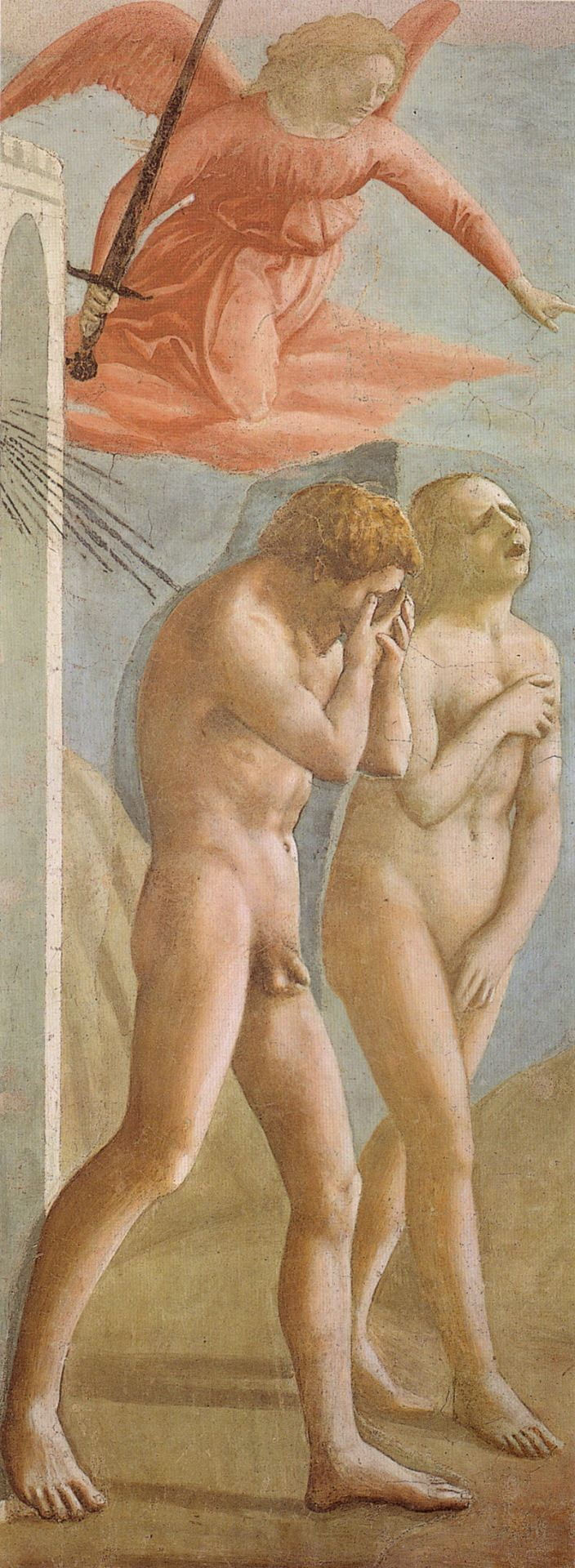
In chapter 4 we move on to their children, and after the first human born becomes the first murderer, of his own brother no less, Cain settles in the land of Nod, east of Eden. Steinbeck understood perfectly well that this space was more than geography. It is the moral topography of the human threshold: outside the garden, deep within its shadow. That bite of freedom from the fruit of the Tree of Knowledge is already starting to come back up.

But Steinbeck does not stop at the metaphor, with all the havoc it wreaks on two generations of brothers. He develops, then cultivates, an obsession with a single word: Timshel. He returns to it in his letters, inscribes it on the wooden box in which he hands over the manuscript, and places it at the heart of the speeches of Lee, the Chinese servant who also becomes a spiritual teacher to the next generation of brothers.

The word becomes the crowning idea of both the novel and his worldview. It emerges from one of the most difficult verses in biblical interpretation, words God speaks to Cain just before he rises against his brother: "At the door sin crouches; its desire is for you, and you will rule over it."
For Steinbeck, timshel means "thou mayest": you may, you might, the choice is yours. Neither a promise that you will rule over sin nor a command to do so, but a possibility.
A lovely idea. But Hebrew, being Hebrew, won't quite play along. Timshol is not timshel, and certainly not simply "thou mayest"; it meant rule then, and still does. Like the rest of us, Steinbeck is a victim of God's antics at the Tower of Babel. And like me – evidence to follow shortly – he is not discovering a hidden meaning in the word but pouring into it the reading he wants. The joke is that the mistake is also largely unnecessary, since the opening of the verse seems to be all about choice: "If you do well, will you not be lifted up / And if you do not do well, at the door sin crouches,” goes the usual translation. Most commentators, including Rashi and Cassuto, read it this way: God offers Cain a choice between submitting to the evil inclination and gaining control over it.
But what does desire have to do with control? Here we should consult an expert: Eve, who in the previous chapter coveted the fruit of the Tree of Knowledge and was punished accordingly: "Your desire is for your man, and he will rule over you." Then, in a biblical blink, almost the same odd linguistic and conceptual structure returns: "Its desire is for you, and you will rule over it." The message becomes clear long before David Hume gets around to recycling it: we are slaves to our desire. Whatever you desire rules you. If the question of liberty, to borrow from Isaiah Berlin, is who rules whom, here is our answer: desire, or more precisely its object, rules everyone who desires it.
With Adam and Eve, this seems almost self-evident. The woman desires her man, and so he will rule over her – becoming, as we know, her husband: her ba'al, Hebrew for husband, master, owner. But semantics and reality complicate the picture. For a start, he is explicitly defined as her man, which means that he too belongs to her, and she is, by implication, his owner. Only a few verses earlier, at the end of the preceding chapter, we were told that a man would leave his parents "and cleave to his wife." Why would he cleave to her unless he too desired her? Cathy, of course, understood this perfectly well. Perhaps better than the man who created her.
It is strange to find almost exactly the same formula – "Your desire is for your man, and he will rule over you" – applied to the crouching sin. You can argue that people desire to sin. But that sin desires people, who therefore can, or should, rule over it? No less strange is that all the commentators, to my knowledge, take this claim for granted, untangling the knot by identifying sin with the evil inclination: an inner force that seeks to bring Cain down but can be restrained. This is a reasonable reading, perhaps even the obvious one. It is not the only one, however, and I think it misses something deeper in this foundational biblical moment, something it reveals about the human condition – and the divine.

To see why I reject the conventional interpretations, let us read the verse in its immediate context: "The LORD looked with favor on Abel and his offering. But on Cain and his offering he did not look with favor. Cain was very angry, and his face fell. And the LORD said to Cain, 'Why are you angry, and why has your face fallen / If you do well, will you not be lifted up / And if you do not do well / at the door sin crouches; its desire is for you, and you will rule over it.'"
Before the cryptic verse, then, God asks a silly question: "Why are you angry, and why has your face fallen?" God knows perfectly well why Cain's face has fallen. Perhaps he is even projecting onto Cain his own wrath at the betrayal he suffered in the garden. Desire, control, jealousy, and dependence are apparently not reserved for human beings.

God's question is neither innocent nor merely rhetorical. It rubs salt into Cain's wounds. It is cruel to Abel too, since the all-knowing God also knows perfectly well where his preference for one brother over the other will shortly lead. If the verse belongs to such a vicious game, why do we assume that God suddenly pulls himself together, abandons the vile humiliation, and turns to moral instruction? Is it not equally plausible that he is still relishing the mockery, still enjoying his campaign of humiliation against Cain – the firstborn of the faithless pair – and against the whole human race?
We can now try a small experiment that Steinbeck, surprisingly, never tried. Instead of distorting timshol, we will leave it exactly where it is and supply a punctuation mark that is absent from the biblical text anyway: "And you will rule over it?" The commentators already add a question mark to "Why has your face fallen?" Why not try one here, in what follows? Suddenly the verse changes its voice. No longer a solemn declaration of human sovereignty, but a taunt: Really, Cain? Sin desires you so much that you will rule over it? Behind the question mark lurks something very close to an exclamation: You will not rule over it. Care to guess who will? Give my regards to Job's Leviathan.
But that leaves the hardest nut to crack – yes, the one on the coconut ice cream. What is this "sin" already crouching at Cain's door before he has murdered his brother? The familiar reading looks forward and sees the future sin, the temptation to murder. Perhaps. But another reading seems more plausible to me precisely because it looks backward, toward a past that, unlike the future, is already well known not only to God but probably to Cain, and certainly to the reader. It is not even the distant past. This happened to Mom and Dad just the other day. If there is an obvious candidate for the "sin" crouching at the door, it is the act that, only a biblical moment earlier, led to the great expulsion and the posting of gatekeepers east of the Garden of Eden: "original sin."

This sin crouches at the door because freedom itself is an experience of the threshold. A person stands before a gate, told that it is meant for them alone, that entry is possible, that the responsibility is theirs alone. Yet the authority that built the gate remains on the other side, apparently forbidding entry, though, like God in the Garden of Eden, it cannot or will not prevent it. If so, the door is none other than the threshold before which the man from the country will take his stand in Kafka's "Before the Law". He will come and crouch like the sin whose desire he feared, foreshadowing Josef K., who will hear the story in the cathedral and, a chapter later, die "like a dog."
And perhaps the mystery that has tormented scholars – why chattat, "sin," is feminine in Hebrew, while rovetz, "crouching," is masculine – was another hint the Bible tossed in the direction of the first woman. Faced with the fruit of the Tree of Knowledge, she dared to lust – desire, anyone? – for beauty, knowledge, and a freedom until then reserved for God alone. The words immediately preceding that "sin" seem only to explain it – or her: the choice between "doing well" and "not doing well." The fruit of the Tree of Knowledge of Good and Evil.
If this reading is right, then sin, in God's eyes, is not choosing evil but the very capacity to choose. It is not about the freedom to desire, or not, the sin but rather about the sin of desiring freedom.
After He expelled Adam and Eve from the Eden, the Almighty has arranged a splendid opportunity to answer their sin with a crime: to deal the lovers who deserted him one last devastating blow, perhaps the most painful of all. One of their children will kill another. And God said: You wanted freedom? You got it. Now let's see you take responsibility. Cain, of course, promptly runs from that responsibility. He did learn something from mom and dad, after all. God gives him the mark that keeps all external harm at bay. But what of a tormenting conscience? If he had one, perhaps Cain, like Cathy, would need that special skill he acquired the last time he saw his brother – to murder his own soul.
And what of God's responsibility for his rage? What mark of Cain will he wear on his forehead? Can we succeed where Steinbeck failed with Cathy (and with Conger) – in understanding him, this betrayed, jealous, frightened God who has just lost his monopoly on commanding obedience and passing judgment? For it seems that the more He saw the desire of human beings for freedom, the more he himself was filled with a desire to "Timshel" over them.
God's terror at losing control is as explicit as the Bible ever allows itself to be. Having turned freedom into sin, he shudders: "Behold, the man has become like one of us, knowing good and evil. And now, lest he reach out his hand and take also from the Tree of Life..." Just don't let him become immortal too. Like me. A few chapters later, at Babel, the same fear returns, even more explicitly: "Behold, they are one people, with one language for them all ... and now nothing they plan to do will be beyond them." In both places, the threat is not a sin already committed but something human beings have just become capable of.
Cain, then, is the little experiment before Babel. God rejects his offering, arouses his jealousy, then asks why he is angry. Cain, unable to hurt the God whose recognition he seeks, directs his rage at the person beside him, who has just received what he himself wanted. Here is the birth of an ancient political and psychological mechanism, still sickeningly familiar today: rage born of vertical subordination is redirected into horizontal violence. Those who cannot strike upward strike sideways. If freedom is a sin against God, he need not abolish it. He need only privatize it. A ruler need not deprive his subjects of freedom; sometimes he need only ensure that each must face it alone. Alone before his own gate, before his own "sin," the subject will discover that he has no control over it, shudder at the responsibility, and take out his frustration on those nearest to him, here on earth.
Babel is the moment when the threat to God's supremacy returns on a larger scale. Human beings cease to be isolated individuals facing their private gates. They become "one people with one language," build together, plan together, and discover that private autonomy can become a means of acting together. Here the good Lord can no longer make do with stirring up murderous jealousy between brothers. A structural intervention is required: confuse their language, scatter them across the earth, dismantle their ability to act together. Divide and rule: the divine answer to human freedom. Some human rulers learned to follow suit.

If the tales of Eden and east of Eden turn on crimes of passion, perhaps we should close with the greatest, most foolish desire of all, the one that surged through Cathy's veins but accompanies us all to some degree: to be godlike, "the One" whom everyone desires, and who desires no one. "Man is a useless passion," Sartre wrote. Perhaps not entirely useless. Think how many magnificent works, including those we have just been musing over, have grown out of this desire. Even so, God is a dubious guide to being human. The omnipotent can control it all, but what does it mean to choose, to agonize over an emotional and moral dilemma, when there is nothing you cannot do? The omniscient knows everything, but what does it mean to hope when there is no future you do not know? And can someone who lacks nothing desire at all, let alone love? Perhaps God has no better idea of what it is like to be us than we have of what it is like to be bats.
If so, perhaps the problem is not that we want to be God, but that we have chosen a model incapable of being human. We must learn freedom and desire, hope and love, not from Him but from one another.


Comments